The First Universal Programmable
Microscope Objective

Shaped to See Beyond the Scattering Limit

UNILENS is the first universal, digitally programmable microscope objective lens

Project Highlights

Project Name
UNILENS
Grant No.
101291914
Duration
36 months
Programme
Horizon Europe EIC Transition
Entity
KYMATONICS PC

Breaking the Depth-to-Resolution Barrier

UNILENS is a Horizon Europe-funded project aimed at revolutionising microscopic imaging. By developing the world’s first universal programmable objective lens, the project will enable deeper, higher-resolution, and non-destructive imaging of biological tissue, unlocking new possibilities in biomedical research, clinical diagnostics, drug discovery, and digital pathology.

The project is led by KYMATONICS, a deep-tech spin-off of FORTH-IESL, bringing together expertise in photonics, adaptive optics, and scalable instrumentation.
The Problem: Why Microscopy Gets Limited

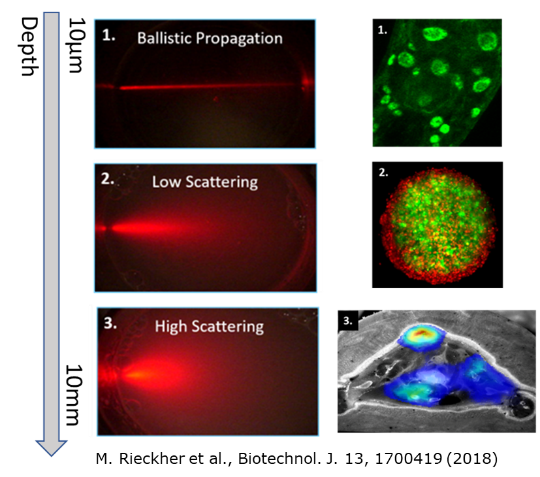
Depth vs. Resolution Trade-off

Multiple scattering and aberrations collapse image fidelity beyond a few hundred micrometres of tissue. The deeper you look, the blurrier it gets.

Static, Single-Purpose Optics

Conventional objectives are fixed hardware. Switching between multiphoton, SIM, or STED requires different lenses, expensive systems, and calibrations.

Destructive Sample Preparation

High-resolution deep imaging demands tissue clearing, slicing, and staining or invasive protocols that destroy the very samples being studied.

The result: imaging depth is limited to <0.5 mm · resolution collapses in tissue · workflows remain slow, expensive and destructive

UNILENS: The Radical Approach

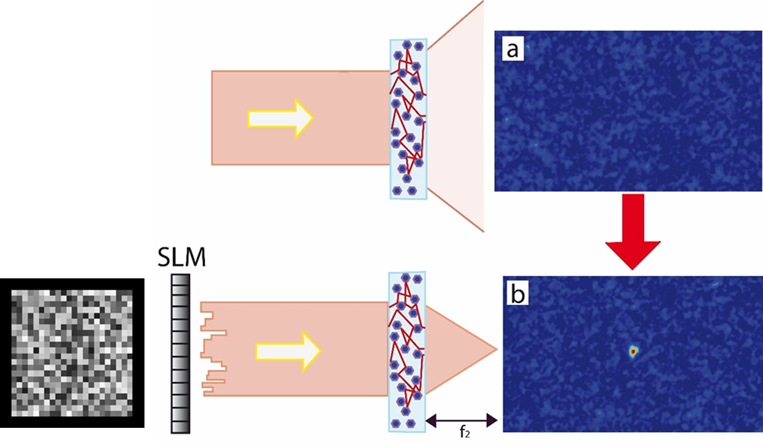
Pre-compensate scattering

The Opaque Lens Concept

Conventional optics treat scattering as noise to be filtered out. UNILENS inverts this logic entirely.

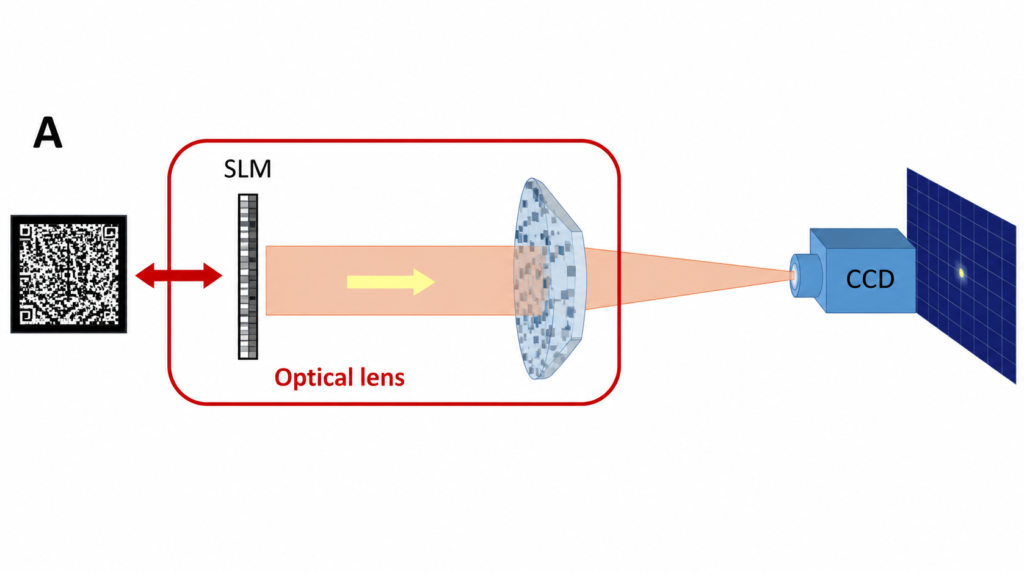
By engineering disordered photonic structures combined with active wavefront control, UNILENS predetermines light propagation through tissue, turning multiple scattering from an obstacle into an enabling tool.

The result: unprecedented imaging depth while preserving high resolution.

Three Core Technology Pillars

01

Inverse-Designed Photonic Plates

Fabrication-aware disordered photonic structures (GLAVKOS) designed using the Wavesim ultrafast simulation platform. Gradient-based optimisation constrained by lithographic tolerances ensures reproducibility at scale.

02

Adaptive Wavefront Control

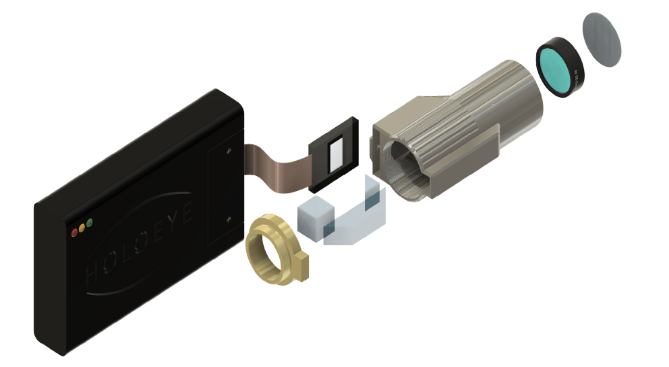
Real-time control algorithms delivering aberration correction at >200 Hz. Phase retrieval via off-axis holography or sensorless metrics and selectable by modality. Low-latency feedback enables live imaging in intact scattering tissue.

03

Universal Modality Switching

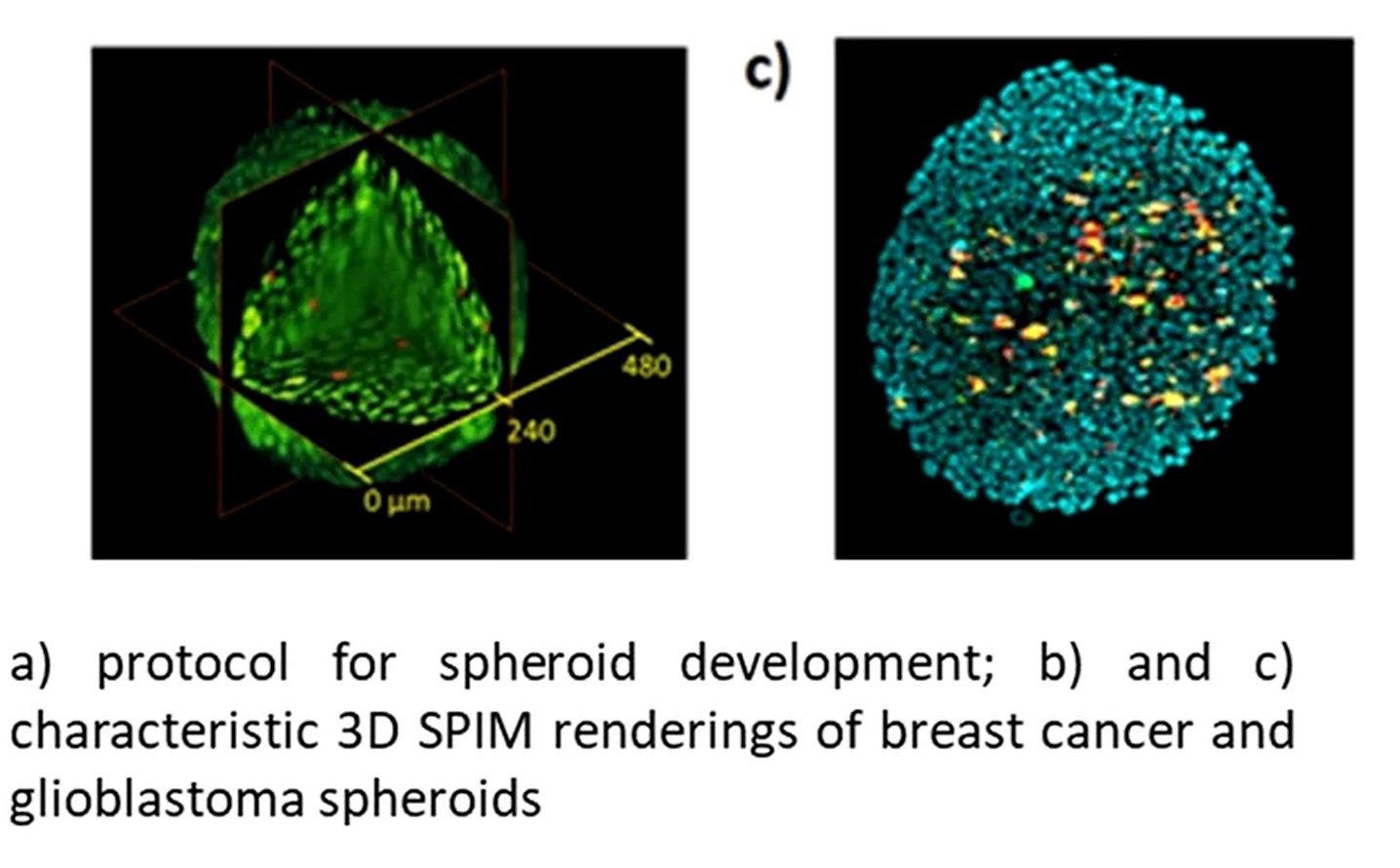
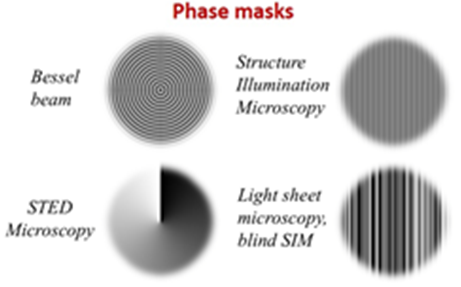
A single UNILENS objective replaces multiple fixed optics. Software-defined switching between multiphoton, structured illumination (SIM), STED-inspired super-resolution, and light-sheet fluorescence microscopy (LSFM).

No moving parts · Drop-in objective replacement · SDK-controlled